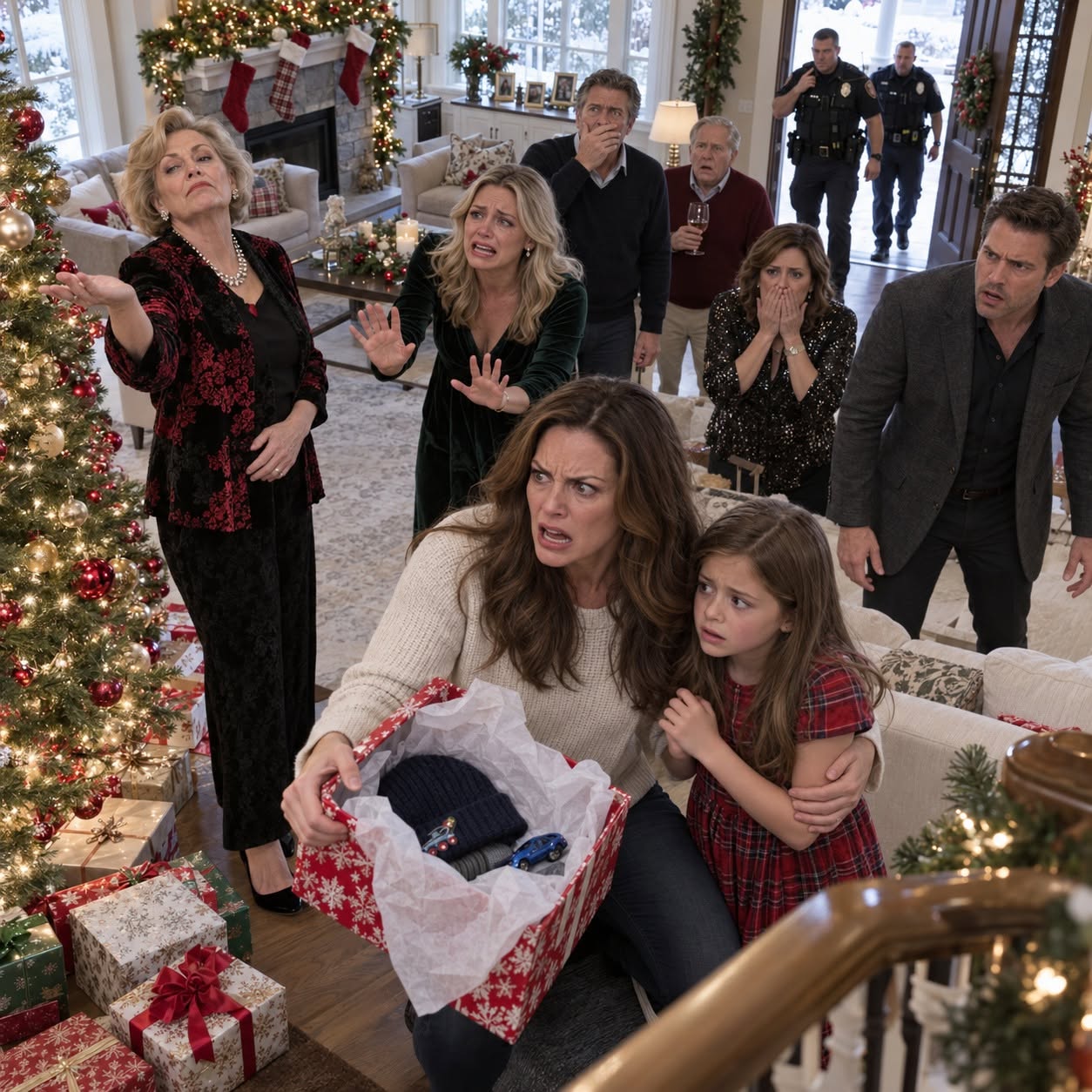
I thought the worst thing my family could do on Christmas was remind my eight-year-old daughter that her brother was still missing. Then she opened a box under my parents’ tree, grabbed my hand, and whispered, “Mommy, I’m scared.” Inside was something my son had carried the day he vanished six months earlier. My mother called it “a harmless lesson.” My sister begged me not to overreact. Five minutes later, I called the police—and Christmas stopped being a holiday and became a crime scene.
If you had asked me that morning what I expected to survive at my parents’ Christmas gathering, I would have said my mother’s dry turkey, my sister Nicole’s passive-aggressive comments, and three hours of pretending our family was more functional than it actually was. My parents’ house smelled of cinnamon oil, baked ham, and the artificial pine spray Mom used even though the tree was real, while cousins squeezed around furniture and children tore through wrapping paper beneath white lights that blinked too quickly. I had almost convinced myself the chaos was good for Lily, because at eight years old my daughter deserved one morning when nobody whispered around her or watched her face for signs that she was thinking about her brother.
Six months earlier, my son Caleb had vanished from his elementary school during lunch. Technically Caleb was my stepson because my husband Daniel had him before we met, but that distinction had never existed inside our house; Caleb had called me Mom since he was three, and when Lily was born he became the most protective big brother I had ever seen. His biological mother, Vanessa, had signed away primary custody years earlier and disappeared from his daily life, so when Caleb went missing there had been no obvious custody dispute, no ransom demand, no clear witness, just one grainy hallway camera showing him walking away from the cafeteria and a backpack discovered several blocks from school.
Our home had become a museum of interrupted routines. Caleb’s blue sneakers stayed beneath the bench by the mudroom until Daniel finally moved them because seeing them every morning made him physically sick, Lily slept with one of Caleb’s old blankets, and I checked unknown phone numbers with the desperate reflex of someone touching a hot stove again and again because one time it might not burn. Daniel and I had promised Lily that Christmas would still happen, not because we felt festive, but because grief had already stolen enough from her.
For the first half hour, it almost worked. Lily laughed when Grandpa Robert gave her an art set, frowned politely at the stiff green dress Grandma Elaine had chosen for her, then squealed when her cousin Avery gave her a ridiculous glitter craft kit that immediately shed silver dust across Mom’s spotless carpet. Nicole leaned against the doorway sipping something from a crystal glass, smiling with the same effortless confidence she had possessed since childhood, while Mom hovered nearby directing everyone like Christmas morning was a production she had personally financed.
Then Lily reached for a medium-sized package wrapped in shiny red paper.
The tag said, “To Lily, from Avery,” in a child’s uneven handwriting. Avery glanced toward Nicole before smiling, and I noticed it only because I had spent six months studying faces, gestures, doorways, security footage, and every other useless detail the human brain grabs when it wants control over the uncontrollable. Mom also stopped moving for half a second, one hand resting on the back of a chair, watching Lily much more carefully than she had watched her open any other present.
Lily lifted the lid.
Her entire expression disappeared.
She did not scream or cry. She simply stared into the box, shoulders rigid, lips slightly parted, and for several seconds the noise of the room continued around her as though nobody had noticed an eight-year-old child suddenly turn white. Then she stood, carried the open box toward me with both hands, pressed herself against my side, and whispered, “Mommy, I’m scared.”
I looked inside.
There was a small plastic glider shaped like a futuristic bird, its silver paint scratched along the underside, one wing carrying a thin crack near the edge. A faded black marker line crossed the tail because Caleb had drawn it there after arguing with another boy who owned the same toy, and I remembered laughing while he told me the line made his “impossible to steal.” My fingers went cold before my brain finished understanding what I was seeing.
Caleb had carried that toy everywhere during the week he disappeared.
The morning he vanished, I had watched him shove it into the side pocket of his backpack while eating toast.
“Where did you get this?” I asked Avery.





